
Serving Waitsburg, Dayton and the Touchet Valley


Serving Waitsburg, Dayton and the Touchet Valley
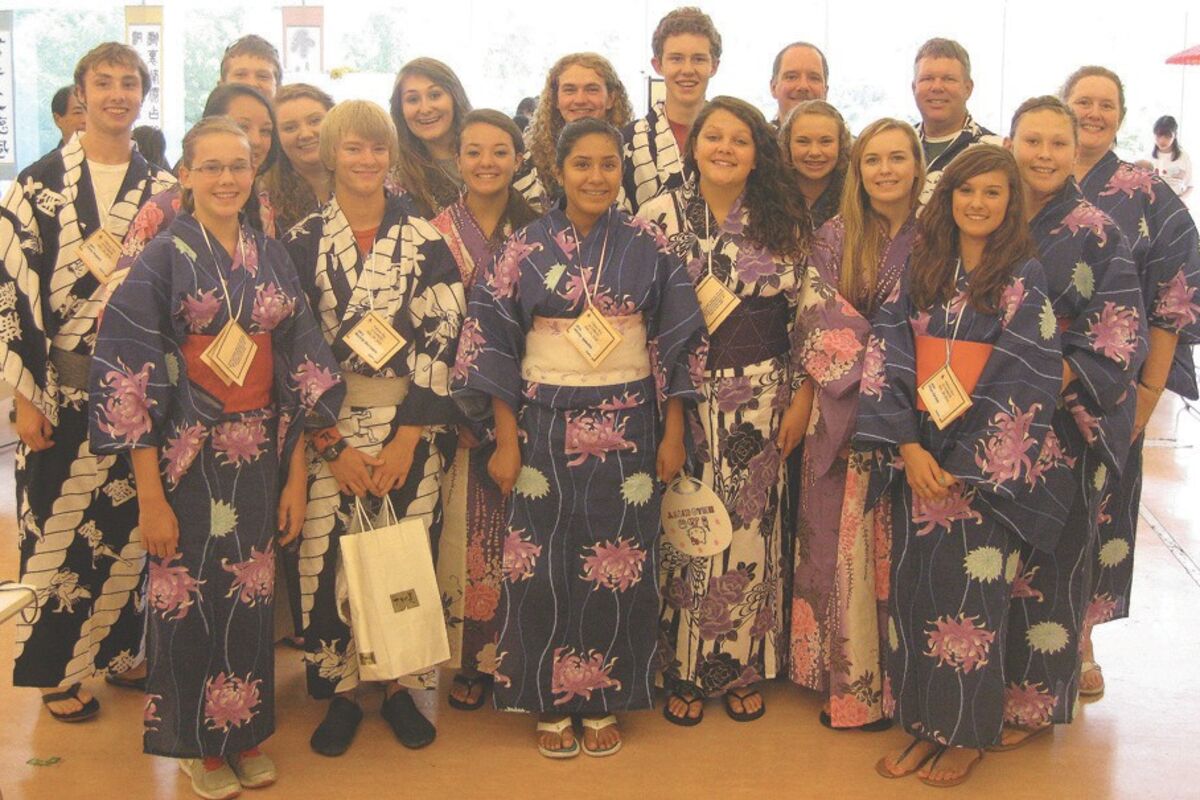
Dayton students pose in the yukatas (casual kimonos) they received as part of their "cultural day" at the Yamate School in Yokohoma, Japan.
Dayton-Yamate exchange students gather for a field trip in the Yokohama area of Japan, where they spent two weeks.
DAYTON - In a tradition that started 44 years ago, 16 students and three chaper- ones returned home Saturday after spending two weeks in Japan as part of an ongoing exchange program between Dayton High School and Ya- mate Gakuin Junior/Senior High School in Yokohoma.
According to Dayton High Exchange Advisor Kristine Warren, the private Yamate school was founded on the idea of international friendship and emphasizes responsible participation in community and international affairs. The founders felt the best way to avoid horrors like those of World War II was to promote friendship between countries.
The school was started in 1966 as a private boys'boarding school and began accepting girls in 1969. Students came from all over Japan to live at the school until boarding was discontinued in the 1980s. Today students come from all over the Yokohama area as well as from south Tokyo and other nearby cities in the Kanagawa Prefecture to attend. It is not unusual for students to travel two hours by train each day to reach the school.
The Japanese school year runs from early April to mid March. Every April, the entire Grade 11 class travels to North American for a two-week exchange. The program began in 1969 when 134 boys stayed in Dayton, Waitsburg and Pomeroy. Warren shared that one of the school's founders had a friend who came to Dayton as a bride where she arranged the initial exchange.
Since then, the program has grown to include other cities in the United States and Canada. In July of each year, students and chaperones from the places the Yamate students visited in April travel to Japan for a reciprocal two-week exchange. Over 1,000 Yamate students have visited Dayton in the last 44 years and nearly 350 Dayton teens have visited Japan.
In years past, Dayton students who had hosted Yamate students in April weren't allowed to stay with that family if they participated in the reciprocal visit in July. This year, for the first time, Yamate students were given first option at hosting students from the family they had exchanged with in April.
"Many families aren't able to host because many Japanese homes are too small," said Warren. "But for those who could, it was wonderful that they were able to build deeper friendships with one another. The thinking has changed from focusing on developing more relationships to seeing the value in deeper relationships."
This year's Dayton group joined with other groups from Walla Walla, Edmonton, Alberta; Regina, Saskatchewan; and Victoria, B.C. There were roughly 150 students and 18 chaperones in all.
Warren has held the position of Yamate Advisor Exchange Coordinator for Dayton High since 2005. As such, she is responsible for finding host families for visting Yamate students, and for scheduling activities for Japanese students visiting Dayton and Dayton students visiting Yokohoma.
Prior to visiting Japan, students attend mandatory meetings in which they are introduced to Japanese customs, learn minimal Japanese language and cover topics such as expectations and the intricacies of international travel.
Students are responsible for paying their own way, but are required to pay only for airfare, travel insurance and to chip in on a gift for the hosting school. This year, the exchange cost was $1,685 per student.
"I think that's extremely reasonable," said Warren, who recalls it being as low as $800 when she first began coordinating in 2005.
Dayton senior Etta Huwe made a deal with her parents to forfeit her "graduation car" in exchange for them paying for her trip. Junior Haley Puckett tackled odd jobs for relatives to raise the necessary funds.
Following a 9.5 hour overseas flight to Japan, the group boarded a bus to Yamate School where they were welcomed in a brief ceremony before meeting and leaving with their host families. Each student's ex- perience is unique because the host families all differ and arrange different family outings.
Huwe toured "lots and lots" of temples with her family, while Puckett vis- ited Landmark Tower - the tallest building in Japan - and attended a baseball game where spectators "sang songs the whole game."
Both girls visited "water parks" but were surprised to find them a far cry from the U.S. versions they knew. Huwe's "water park" con- sisted of hot and cold springs in different colors like "green tea" and "purple wine" and a marble slab to lie and relax on. There was even a pool where she could dip her feet and little fish would eat the dead skin.
Puckett's "water park" consisted of various "fancy" scented rooms where one could sit in a chair and be splashed with water at vary- ing strengths and spray settings. Both parks were designed for relaxation rather than recreation.
Junior Matthew Warren was especially impressed by fireworks displays that he felt far outshone any in this country.
"Take every fireworks dis- play you've ever seen in your whole life and roll them all into one and it still wouldn't match the ones we saw in Japan," he said.
In addition to individual outings and experiences shared with their host fami- lies, the students gathered for three group field trips and one "cultural day."
The group first toured sites in Yokohama, the sec- ond most populous city in Japan (after Tokyo), with a population of 3.7 million. In Yokohama, the group visited Japanese gardens and Sea Paradise, which is akin to Sea World. Their second field trip was to Tokyo Dis- neyland, which was a gift paid for by the parents' as- sociation at Yamate School. Finally, the group visited To- kyo where they took a river boat cruise on the Sumida River, shopped for traditional Japanese items in Asakusa and visited the Edo-Tokyo Museum where they learned about Tokyo's history and culture.
The "cultural day" took place at the Yamate School where students took turns visiting different booths and practicing various skills. Stu- dents learned to take part in a Japanese tea ceremony, write their name in calligraphy, eat with chopsticks, decorate fans, cook noodles and play traditional Japanese games. Each student was given a yukata, a casual summer kimono made of cotton, to wear for the day and take home.
Each of the students who spoke with The Times re- marked how much Japanese citizens rely on mass transportation and how crowded the trains and busses are.
"You are literally standing like sardines," said Huwe. "It takes a bit of getting used to."
The students also spoke of the great respect and generosity Japanese people bestow on those they came in contact with.
"I didn't realize how dif- ferent we were until I was in another culture and saw how polite they were," said Jen- nifer Warren. "They would never ask for something and not say please or thank you."
And that's the goal.
"Looking at another culture and experiencing it firsthand -- different ways of eating, thinking and liv- ing - is pretty special," said Coordinator Warren. "Going from a city of 2,500 to one of 3.7 million is a big jump!"
Warren was especially pleased that many of the stu- dents were able to live with or at least reconnect with the Yamate students they had met in Dayton this past April.
"They are building bonds that will last," she said. "It's a pretty cool thing to have a friend on the other side of the world."







Reader Comments(0)